Why India's Young Traders Keep Losing Money and How Virtual Trading Labs Can Fix It
Nearly nine out of ten Indians who traded futures and options in FY26 lost money. That one number says a lot about how the country is learning to trade.
India has never had more people in its stock market. Opening a demat account takes ten minutes. Trading apps are free, fast and designed to keep you tapping. Finfluencers explain option strategies on reels that last less than a minute.
Access is no longer the problem. Preparation is.
Most new traders don't lose money because they are careless. Many of them have watched hours of videos, read the books and can explain what an option premium is. What they have never done is practise. Their first real lesson in risk is their first real trade, made with their own savings.
In this article, we look at what SEBI's latest data tells us about India's retail traders. We explain why theory alone keeps failing them, and how a virtual trading platform inside a finance institute can close the gap between knowing the market and surviving it.
The numbers behind India's F&O losses
SEBI's August 2026 studies on individual traders in the equity derivatives segment make uncomfortable reading. Here is what they found for FY26.
| Indicator (FY26 unless stated) | Figure |
|---|---|
| Individual F&O traders who made a net loss | 87.7% |
| Aggregate net loss of individual traders | ₹91,685 crore |
| Average net loss per trader | About ₹1.17 lakh |
| Share of traders below age 30 | 43% (up from 31% in FY22) |
| Traders below 30 who lost money | 88.5% |
| Share of retail losses that came from options | 92% |
Sources: Business Today, Free Press Journal, New Kerala, Finnovate, Outlook Business.
This is not a one-year blip. SEBI's earlier study found that 93% of individual F&O traders lost money between FY22 and FY24, with combined losses of over ₹1.8 lakh crore. The regulator has since tightened the rules, and participation has fallen. Yet the share of loss-makers has barely moved.
Two details deserve attention.
The first is age. Young traders are now the single biggest group in the derivatives market, and they are losing at the same rate as everyone else. Many of them are students, fresh graduates or early-career professionals, which is exactly the group that finance institutes teach.
The second is cost. SEBI found that 82.1% of traders were already in the red before transaction costs. After brokerage, taxes and fees, that rose to 87.7%. Most beginners never calculate this before they start. They learn it from their contract notes.
All of this sits against a market that keeps growing. India crossed 13.2 crore registered investors in 2026, up from 2.7 crore in FY19. The newest one crore investors joined in about six months. The funnel into the market is wide open. What happens inside it is the problem.
Why knowing the market is not the same as trading it
Ask any finance educator and you will hear some version of the same story. A student scores well on derivatives, understands the Greeks and can draw a payoff diagram in seconds. Then they open a live account, take a position, and freeze the moment it moves against them.
That gap between knowledge and behaviour is where most of the losses come from.
Every serious profession already accepts this. A pilot logs hours in a flight simulator before flying passengers. A surgeon practises under supervision before operating alone. A cricketer faces thousands of balls in the nets before facing one in a match. Nobody calls that a waste of time. It is simply how skill is built.
Trading has mostly skipped this step. Classroom teaching covers concepts. Real money covers consequences. There is very little in between.
Here is what a student usually cannot learn from a lecture alone:
- How costs change outcomes. A strategy that looks profitable on paper can lose money once brokerage, STT, exchange charges and slippage are added. Seeing that on a personal P&L sticks far better than reading it on a slide.
- How position size decides survival. Beginners tend to size trades on conviction rather than risk. One oversized loss can wipe out ten good trades.
- How emotion takes over. Holding a losing trade too long, booking a winner too early, revenge trading after a bad day: these are behaviours, not knowledge gaps. They only show up when there is something at stake.
- How to review and improve. Good traders keep records, study their mistakes and adjust. Most new traders never build that habit because nobody asked them to.
None of this needs real money to learn. It needs repetition, feedback and a safe place to fail. That is what a well-designed virtual trading environment provides.
What a virtual trading lab looks like inside an institute
A virtual trading lab is a stock market simulator built for teaching. Students get virtual capital and trade in an environment that behaves like a real market, with real order types, margins and charges. No real money changes hands, and nothing can be lost except pride.
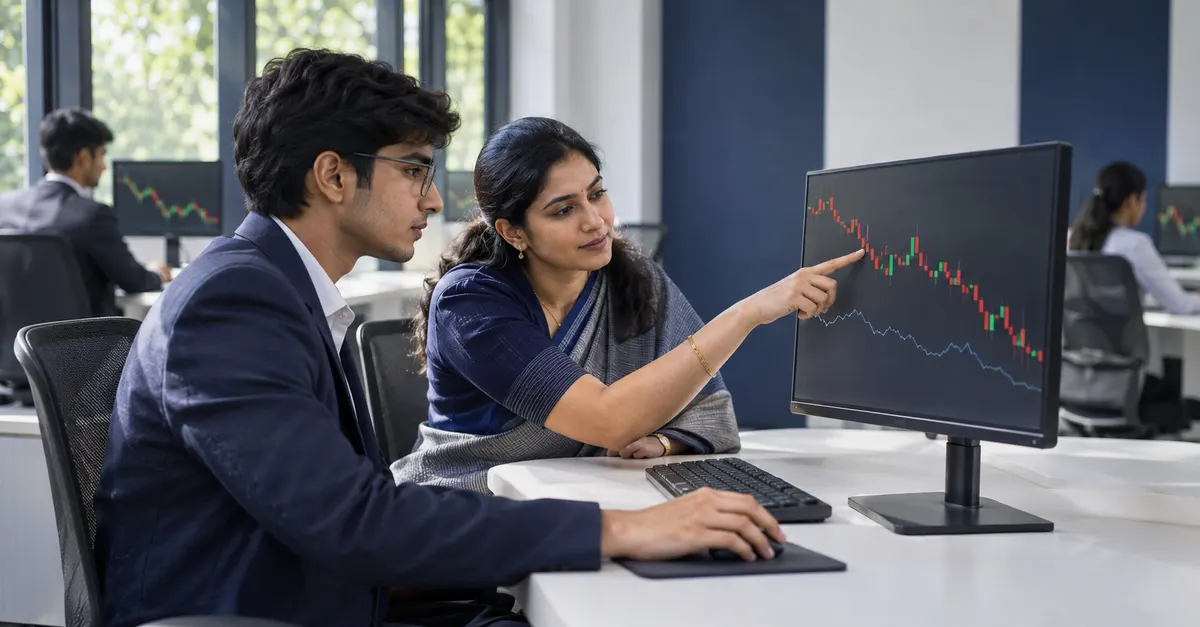
The idea is not new. Many retail apps offer some form of paper trading. What makes an institutional platform different is that it is designed around a classroom rather than an individual.
In practice, it usually works like this:
- The institute sets up a batch. Faculty create a cohort, allot virtual capital to each student and choose which segments are open, such as equity, futures or options.
- Students trade through the course. As each concept is taught in class, students apply it on the platform. A lecture on covered calls is followed by students actually placing one and watching how it behaves.
- Every action is recorded. Orders, exits, position sizes and P&L are logged automatically. Students write short notes on why they took each trade.
- Faculty review and guide. Instructors see each student's activity on a dashboard. They can spot over-trading, poor risk control or a strategy that works, and discuss it in the next session.
- Assessment becomes practical. Instead of grading only written exams, institutes can assess how students manage a portfolio over weeks, including how they handle drawdowns.
This turns trading education from something students hear about into something they do. It also gives the institute a clear, measurable outcome to show prospective students: our graduates have already placed hundreds of trades and learned from them.
Features to look for in virtual trading software for institutes
Not every simulator is built for education. If you run a finance institute, an academy or a university department, these are the features that make the real difference.
1. Realistic order types and execution Students should be able to place market, limit, stop-loss and bracket orders, just as they would on a broker's terminal. If the practice platform feels nothing like the real one, the skills won't transfer.
2. Margins, brokerage and taxes built in This is the feature most free simulators skip, and the one that matters most. SEBI's data shows transaction costs alone pushed thousands of traders from small gains into net losses. Students need to see that happen to their own virtual portfolio.
3. Coverage of equity, futures and options Given that options account for most retail losses, an institutional platform must let students build and manage option positions, including multi-leg strategies, and see how premiums decay over time.
4. Risk analytics for every student Drawdown, win rate, average gain against average loss and capital at risk per trade tell a far richer story than a single P&L figure. They show whether a student is disciplined or just lucky.
5. A trade journal A simple prompt to record the reason for every entry and exit builds the reflective habit that separates consistent traders from gamblers.
6. An instructor dashboard Faculty should see the whole batch at a glance, drill into any student, and export reports for assessment. Without this, a simulator is just an app students use alone.
7. Challenges and leaderboards Class competitions make practice engaging. They should reward risk-adjusted performance, not just the biggest return, so students learn that survival matters more than one lucky trade.
8. White-labelling and easy access The platform should carry the institute's own brand, work on web and mobile, and let students log in with institute credentials. That makes it feel like part of the course, not an add-on.
Staying on the right side of SEBI's market data rules
Any institute planning a virtual trading programme in India needs to understand one regulatory point: how market price data can be used for education.
In May 2024, SEBI barred exchanges and intermediaries from sharing real-time price data with platforms offering virtual trading or fantasy games based on live share prices. The concern was simple. Some apps had turned paper trading into something close to a stock-market casino, with entry fees and cash prizes tied to live price swings.
The rules have tightened since. SEBI warned investors against such platforms in November 2024. According to market commentary, a uniform 30-day lag for price data used in investor education has applied from 1 July 2026.
For institutes, this is good news rather than a barrier. It separates genuine education from speculation dressed up as learning. A compliant virtual trading lab should:
- Use market data in a way the rules allow, such as delayed data, historical replay or a properly licensed feed
- Offer no monetary rewards linked to virtual portfolio performance
- Present itself clearly as a learning tool, not as trading tips or advice
Historical replay deserves a special mention. Letting students trade through real past events, such as a budget day, an election result or a sharp market fall, often teaches more than live data would. Students experience the volatility without anyone handing them a live tip.
Regulations change, so institutes should always confirm the current position with their compliance or legal advisers before launching a programme.
How SparrowBytes builds virtual trading platforms for institutes
At SparrowBytes FinTech Solutions, we build virtual trading software for financial institutes, trading academies and universities. Our platforms let students learn the market and practise trading in a realistic virtual environment, while faculty guide them with clear data on every decision.
We started from a simple belief: students should make their first hundred mistakes in a classroom, not in their bank account.
What that means in practice:
- Built for teaching, not just trading. Batch management, instructor dashboards, student reports and assessment tools come as standard.
- Real-market experience. Realistic order types, margins and charges across equity, futures and options, so habits formed in the lab carry over to real trading.
- Risk-first learning. Every student sees their drawdowns, risk per trade and cost impact, not just their returns.
- Your brand, your platform. White-labelled for your institute on web and mobile, so it feels like part of your curriculum.
- Designed with compliance in mind. We work with institutes to set up data and features in line with current SEBI guidance for educational use.
Behind this is the same engineering that powers our wider fintech work in digital payment integration, BBPS and personal finance tools: secure, scalable systems built for the Indian market.
If your institute wants to give students hands-on market experience, we would be glad to show you a demo. Visit sparrowbytes.com to get in touch.
Frequently asked questions
What is a virtual trading platform?
It is a stock market simulator where users trade with virtual money in a market-like environment. It lets learners practise strategies and risk management without risking real capital.
Is virtual trading legal in India?
Yes, when it is used for genuine education. SEBI restricts the use of real-time price data by virtual trading platforms and bars monetary incentives tied to virtual portfolios. Educational platforms should follow current SEBI data norms.
Why should finance institutes offer virtual trading?
It gives students practical experience, builds disciplined habits and makes assessment more meaningful. It also helps institutes stand out by showing measurable, hands-on learning outcomes.
Can students practise options trading on a simulator?
A good institutional platform supports options, including multi-leg strategies, so students understand premiums, time decay and risk before trading with real money.
The bottom line
India's investor base will keep growing, and young people will keep entering the market. Better rules alone cannot stop the losses. What they need is somewhere to practise before their own money is on the line.
Finance institutes are best placed to provide that. With the right virtual trading platform, the lessons that today cost young traders over a lakh of rupees can be learned in a classroom instead.
The mistakes are going to happen anyway. The only question is where.
Sources
- SEBI: Trading Behaviour of Individual Traders in the Equity Derivatives Segment (FY25–FY26)
- Business Today: 87.7% of F&O traders lost money in FY26
- Open Magazine: SEBI F&O loss study explained
- 5paisa: India's registered investor base crosses 13.2 crore
- Finshots: Why SEBI wants trading academies to step back from live data